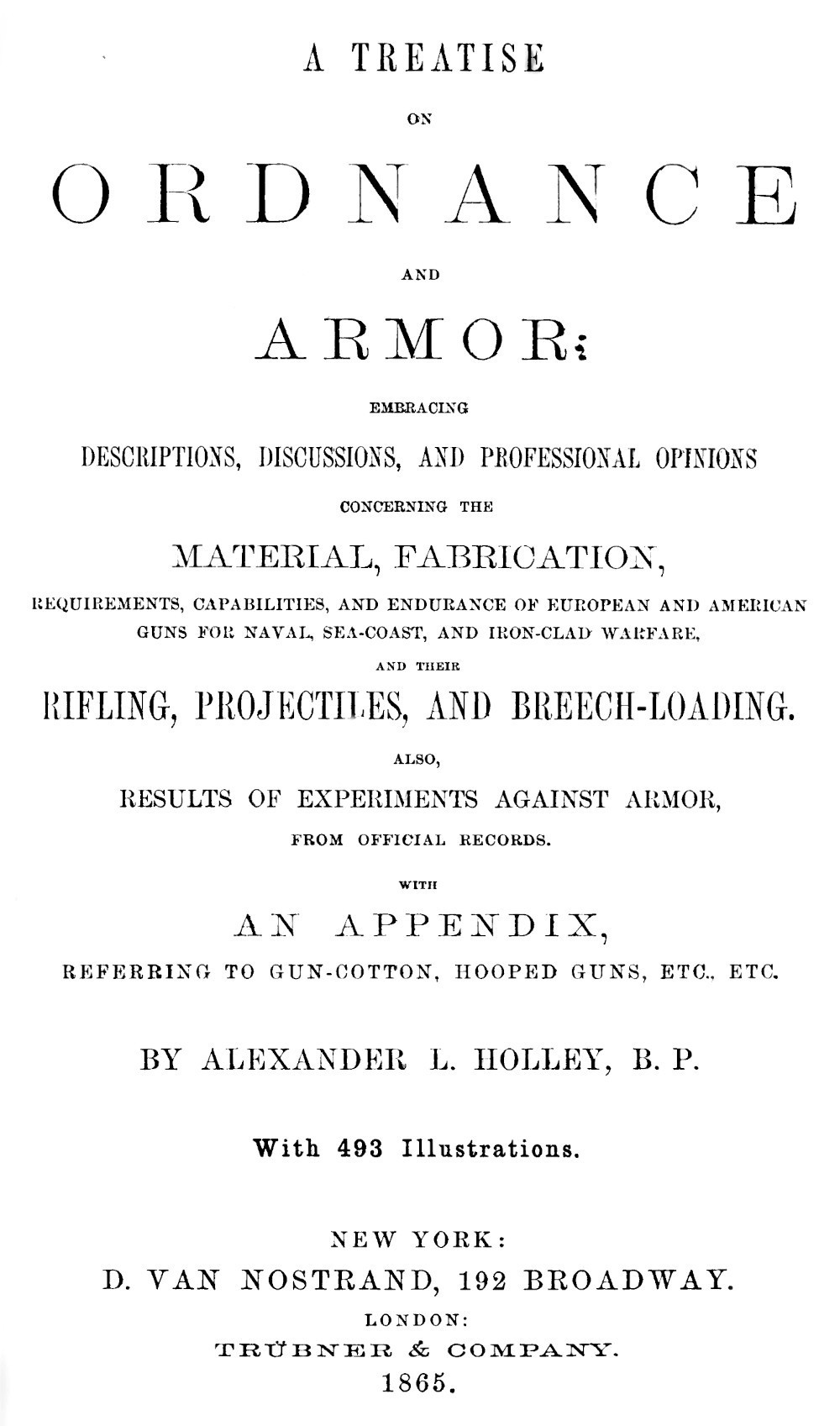
Tu można pobrać książkę w wersji elektronicznej: archive.org
Za autorem" Chociaż ogólnie uznaje się brak prac nad budową, wymaganiami i wynikami nowoczesnego uzbrojenia, próba dostarczenia jej przez inżyniera budownictwa wymaga słowa wyjaśnienia. W Europie ulepszanie i wytwarzanie uzbrojenia, a w Ameryce dodatkowa okupacja wojenna tak pochłonęła uwagę profesji, że kompilacja i publikacja wyników oraz praktyka zostały prawie całkowicie zaniedbane. Podczas kilku wizyt w Europie, w odniesieniu do własnej profesji, autor miał różne i być może niezwykłe ułatwienia w zdobywaniu informacji na ten temat. Jego pierwszym zamiarem, widząc, że wiele faktów nie zostało opublikowanych, było zebranie ich razem w formie jednej lub kilku broszur, z wystarczającą ilością komentarzy, aby uczynić je jednorodnymi. Jednak niektóre relacje z praktyki amerykańskiej wydawały mi się niezbędne Streszczenie opinii ekspertów, profesjonalistów i innych specjalistów, było oczywiście odpowiednie i użyteczne; a ponieważ na opracowanie sprawy poświęcono tylko przerwy w zajęciach zawodowych, czas nieustannie rozwijał nowe fazy, które oczywiście należy wziąć pod uwagę. Tak więc to, co pierwotnie miało być zwykłym zapisem wyników, nieumyślnie i być może nieuchronnie rozrosło się do niniejszego traktatu. Jeśli obszerne i z pewnością ważne fakty zostaną przedstawione w taki sposób, aby pomóc profesji w doskonaleniu wielkiej sztuki obronnej, spełnią się najwyższe oczekiwania autora. Co do dyskusji i konkluzji, powinien powiedzieć, sprawiedliwie wobec siebie, że chociaż nie były one wspomagane przez profesjonalne szkolenie i doświadczenie, z pewnością nie miały na nie wpływu stronniczość, ani zawodowe tradycje i uprzedzenia."
Spis treści w j. angielskim:
- Standard guns and their fabrication described.
- The Armstrong gun. Details of fabrication: breech-loading; rifling; particulars, charges, and number made; proof; service and experimental guns described; cost; endurance; the new british gun.
- The Whitworth gun. Principles; fabrication; rifling; particulars and charges; notes on history and cost.
- The Blakely gun. Structure; two principles involved; particulars and charges; description of guns; treatment of steel and fabrication; early experiments.
- The Parrott gun. Fabrication : material; particulars; ammunition; rifling; endurance.
- Miscellaneous hooped guns. Spanish guns structure and endurance; french guns structure, particulars, and endurance; particulars and endurance of cast-iron guns tested by ordnance select committee; Longridge's wire-wound guns and cylinders details of structure and experiments; Brooke's hooped gun particulars; Attick's bronze reinforce; Atwater gun; Bumford 12-in. Gun hooped; Mallet's 36-in. mortar.
- Solid wrought-iron guns.
- The Mersey Steel and Iron Company's guns. The Horsfall gun; fabrication, particulars, and endurance; the Prince Alfred gun; Brooklyn Navy Yard 12-in. gun; new guns for british government - particulars and endurance. The Stockton guns. Miscellaneous solid wrought-iron guns - Thomas's, Ericsson's, Ames's.
- Solid steel guns.
- Krupp's guns. Fabrication; Relative Strength; Weight and Cost; Description of 8 and 9-in. guns, and guns for Russia; Details of Endurance in England and France; Capacity of Works. Bessemer guns. Production and Character of the Material; Test; Prices; Naylor, Vickers & Co.'s gun-steel; Details of test of 20-Pounder; Mushet and Clare's 20-Pounder; Endurance. Mersey puddled-steel guns.
- Cast-iron gun.
- Rodman and Dahlgren guns. Figure, fabrication, and test of hollow-cast guns; Test of new ordnance; Columbians; New guns 20-in. guns; Particulars and charges of U. S. Army and Navy Ordnance; British cast-iron guns endurance, Particulars, and charges; Miscellaneous cast-iron guns and mortars particulars and charges; Russian cast-iron guns cost of guns.
- The requirements of guns armor.
- The Work to be Done. Necessity of Iron-Clads; Unsettled State of the question; Two systems of destroying an Ironclad Enemy; Racking and punching denned and Illustrated; Effect of velocity; One gun cannot do both kinds of work.
- Heavy shot at low velocities. Experiments - 15-in. Ball, 10-in. Iron; 11-in. ball, 10-in. Iron; 11-in. ball, 14-in. iron; 15 and 11-in. balls and Parrott 150-lb. Bolt - Various Plates- Late Experiments; 15-in. ball, ironclad "ATLANTA"; 13-in. steel shell, "WARRIOR" target; 13-in. steel bolt, 11-in. iron; 13-in. ball, 4 3/8-in. iron; 13-in. ball and 131-lb. steel shot, "WARRIOR" target; 10-in. Ball, "WARRIOR" target; 150, 230, and 307-lb. bolts and 113-lb. ball, and 12 and 13-in. target; 300 and 330-lb. Bolt, 7½ in. target; 10½ in. ball, Scott Russell's Target; 10½ in. ball, "MINOTAUR" target; 301-lb. bolt and 150-lb. ball, Chalmers target; 150-lb. ball and 300-lb. bolt, "BELLEROPHON" Target; 110-Pounder, Plates on Masonry.
- Detaching armor by heavy shot. Considered. Quality of Plates; Fastening armor; Targets compared as to effect of vibration; 15-in. ball better than rifle-bolts.
- Solid and laminated armor. Strength compared; Inferior resistance of laminated; 68-pounder and 110-pounder against laminated 6-in. and 10-in. targets; Backing; 130-lb. ball against 6½-in. laminated target compared with 150-lb. ball on 4½-in. solid plate; Cause of greater resistance of solid plate; Solid and laminated armor combined; Wire-rope bolt.
- Smashing ships' sides by heavy shot, considered. Cannot be judged from small targets; lllustrations; Popular theory of destroying armor by shot of medium weights and velocities its error; Local effect prevents distributed effect, and vice versa; Examples; Object not to destroy armor, but the enemy within it.
- Ductility of armor saves the vessel under very low velocities of shot. Effect of Rams; Ductility illustrated by Thames Iron Works Plate; Difference in quality of armor illustrated by American and English Plates.
- Difficulty of adapting the heavy shot system. Difference in range and armor changes conditions of useful effect; Other defects of the system; Too much time required; Armor hurt more than the enemy; Illustrations; Broken plates still a protection against shells; Greater strains in large guns; Blakely's and Scott's calculations.
- Advantage op single heavy shot over many light shot. Commander Scott's results; Effect of salvos; Recapitulation.
- Small Snot at high velocities.
- Experiments. Law of Resistance; Quality of armor; 10½-in. ball, "WARRIOR" target; 10½-in. ball, "MINOTAUR" target; 13-in. ball, "WARRIOR" target; 301-lb. bolt, Chalmers target; 130-lb. steel shell, "WARRIOR" target; 151-lb. and 130-lb. steel shells, 4½ and 5½-in. plates; 288-lb. steel shell, 5½in. plate; 148-lb. steel shell, 5½-in. plate; 300-lb. steel shells, 4½-in. plate (Russian Experiments); 610-lb. bolt, "WARRIOR" target; 15-in. ball, 6-in. iron; 11-in. ball, 4½-in. plate, wood backing and pacing.
- American armor-punching guns considered.
- Conditions of greatest effect. Law of Penetration; Examples; Conditions of high velocity; Mr. M. Scott's and Sir W. Armstrong's views; Velocity of round and rifled shots; Remediable defects of the smooth-bore; Captain Fishbourne's views; Greater liability of balls to waste power in self-destruction, and their greater penetrating area; Effect of lead shot on iron plates; Merits and defects of Light elongated projectiles.; Sub-calibre projectiles; Necessity of rifling; Armor-punching shells; Long range Fighting; Loss of velocity of round shot.
- Range of iron-clad warfare. Probability of Short Range; Importance of rifles for other purposes; Kind of rifles required.
- Shot of large diameters. Ranges of large balls 13-in., 15-in., 9,22-in.; Strain of large balls on the gun; Professor Treadwell's Views.
- Merits and defects of the system. Least Power wasted by high velocities and at short ranges; Destructive effects in turrets; Splinters; Illustrations; Sir Howard Douglass's views; Advantage of laminated armor in this regard; Punching below water; Mr. Whitworth's Experiments; Armor punching shells; Effects considered.
- The two systems combined.
- Merits and defects of each reviewed; The two kinds of shot prepare the way for each other, and less power is wasted. General conclusions.
- Breaching masonry.
- Abstract of report of ordnance select committee on breaching martello towers with smooth-bored and rifled guns. Towers, guns, and charges; Expenditure of ammunition; Masonry displaced; Times of plight; Velocity; Conclusions on the value of different projectiles.
- Breaching fort Pulaski (From the report of General Gillmore). Description of work; Shot fired; Guns; Penetration; Conclusions.
- Breaching fort Sumter (From the Report of General Gillmore). The Work; Ranges and nature of batteries; Projectiles thrown; Character of breach.
- Breaching fort Wagner (From the Report of General Gillmore). Metal required to remove sand armor.
- The strains and structure of guns.
- Resistance to elastic pressure. Pressure. Four kinds of strains brought on guns, and their relation.
- Increasing the thickness of the walls. Rule for Increase of strength ; Illustrations; Captain Blakely's, Professor Treadwell's, and Mr. Longridge's demonstrations.
- Hoops with initial tension. Theory; Professor Treadwell's plan; Another use of hoops.
- Defects of the system. Want of continuity; Mr. Longridge's demonstration; Theoretical accuracy of tension; Difficulty of attaining it.
- Forcing on hoops. Shrinking on hoops; Unequal shrinkage of metal; Experiments; Want of continuity of substance; Permanent enlargement of hoops under strain; Elasticity; Safety due to ductile hoops; Influence of ranges
of elasticity in different parts; Defects of wrought-iron hoops in this regard. - Longitudinal strength. Dahlgren's breech-strap; Views of Siemens, Blakely, Parsons, and Lancaster; How provided by Whitworth, Lancaster, Blakely, Parrott, and Armstrong; Length of hoops.
- Wire-wound tubes. Defects and advantages.
- Hoops with varying elasticity. Theory; Advantages; Notes on the origin of the system; Experiments; Mr. Parsons' s method and demonstration; Defects; Captain Palliser's theory, method, and experiments; Captain Blakely's specification and practice.
- Resistance to elastic pressure. Pressure. Four kinds of strains brought on guns, and their relation.
- The effects of vibration.
- The effects of heat.
- Theory; Mr. Wiard's views; Remedy; Conclusions.
- Cannon metals and processes of fabrication.
- Elasticity and ductility.
- Elasticity. Use; Limit of in metals experiments; Heavy and light forgings; Statements of Colburn, Clark, Mallet, and Anderson.
- Ductility. Gain of strength by stretching experiments; Effect of sudden vibration and different rates of application of force; Experiments; Safety of ductility in guns; Work done in stretching metals to and beyond the elastic limit; Mr. Mallet's reasoning and illustrations.
- Cast Iron.
- Weakness a serious objection; Tensile strength; American and British irons; Rifled guns; Endurance of guns; Greater shrinkage of strong irons experiments cause; Want of uniformity in the same and different irons; Chemical differences; Detection of failure in guns.
- Defects in founding. Solid-cast guns; Initial strains; Effect of time in removing strains; Effect of heat of firing; Want of density in the grim.
- Improvements in founding rodman's process. Hollow casting; Objects; Requirements; Effects of rapid and slow cooling; Defects from exterior cooling; Actual state of strain in the gun; Advantages; Effects of heat of firing; Density of metal.
- Wiard's process. Object; Structure of gun; Probable advantages and defects; State of strain; Effect of heat of firing.
- Shape or guns. Effect of Re-entering angles on initial strength.
- Resistance to concussion and wear.
- Weight and cost.
- Wrought iron.
- Tensile Strength; Uniformity; Deterioration causes; Detection of weakness; Safety; Resistance to compression and wear; Experiments; Testimony about Armstrong guns; Compression of gun-chambers; Hardness; Manner of corrosion.
- Want of homogeneity. Welds; Strength of coils in Armstrong gun; Shape; Weight and cost of guns.
- Systems of fabricating - wrought-iron guns solid forging. Defects imperfect welds; Causes; Maintained heat; Longitudinal direction of fibre; Effect of; Small hammers; Effects of; Unequal cooling and contraction; Experiments and illustrations; Strength of iron in large forgings; Advantages of the process; Failure of forged guns; the "Peacemaker;" Fabrication; Appearance of fracture; Strength of metal; Professional opinions.
- Hollow forging and rolling. Mersey Iron and Steel Company's process; Griffen's process; Rolling up a gun from a plate; Yeakel's plan; Ames's process.
- The Armstrong gun. Process of fabrication; Leading features; Advantages of the system; Strength and endurance of guns; Guns returned for repair; Nature of injury. Defects of the system; Failures before Issue; Softness and compression by the powder-gas; Examples; Stretching of hoops ; Fracture due to vibration; Failure of 10½-in. guns; Causes; Defects of 120-Pounder shunt and small guns; Defective welds; Resistance to enemies' shot; The system for heavy guns considered; Great cost of the process.
- Welding. Nature of the process; How to perfect it; Cinder; Shape of surfaces; Exclusion of oxide; Gas welding; Bertram's process and results.
- Hitchcock's system of fabricating guns. Description; Principles; Comparison with Armstrong system; Making hoops of iron and steel.
- Steel.
- High and low steel defined; Uses of elasticity and ductility iron and steel compared; Work of guns and armor-plates compared; Steel hoops; Cost, Weight, Quality; Improvements and prospects of the steel manufacture; Causes of previous failure of steel guns; Strength of steel; Uniformity; Temper test by specific gravity; Effect of treatment; Resistance to compression and wear; Strains on a homogeneous tube remedies.
- Methods op producing steel. Puddled steel; Low crucible Steel; Krupp's steel specimens exhibited; Bessemer steel process illustrated to be used in America specimens produced; Aboukoff's steel: French and American experiments.
- Systems op fabrication. Solid forging; Forging hollow; Compressing by hydraulic machinery; Rolling and joining hoops; Solid Cast-steel guns.
- Bronze.
- Properties; Fitness for guns; Strength; Difficulties of manufacture; Where and how successfully used.
- Other alloys.
- Phosphorus and aluminium with copper properties and strength; Sterro-Metal; Austrian and English experiments on its strength and properties.
- Conclusions.
- Elasticity and ductility.
- Rifling and projectiles standard forms and practice described.
- Early experiment.
- Russian; Cavalli's; Wahrendorf's; Timmerhaus's; Germs of all the present systems.
- The Centering System.
- Explanation; Modifications; French, early, present, and experimental; Field and naval Guns.
- Austrian. Early; Modern for Gun-cotton ; Eccentric shot; Russian; Spanish; French system in other European countries.
- Lancaster. In the Crimea; Experimental. "HADDAN"; Early and experimental.
- Whitworth. Principles and improvements illustrated; Machine-dressed projectiles; Standard projectiles; Tables of practice.
- Scott's "Centrical" system; Explanation; Experimental projectiles; Lynall Thomas's new system; Like Scott's; practice.
- Sawyer; Pattison.
- The compresing system.
- Explanation; Early Prussian.
- Armstrong. Principles and changes ; Going out of use ; Coating projectiles with lead; Segmental shell; Cartridges; Tables of practice; Armstrong and Whitworth competition.
- Shunt. Principles and operation; Changes; Table of practice; Particulars and results of 600-pounder; Russian shunt rifling; Particulars.
- The expansion system.
- Explanation; American system; James; Hotchkiss; Lynall Thomas's early results; Schenkl; Reed; Blakely.
- Parrott; Particulars; Diagrams of accuracy; Tables of range, pressure, practice, and endurance.
- Stafford, Buckle, Jeffery, Britten; Experiments and charges.
- Armor-punching projectiles.
- Whitworth; Manufacture of shot and shells; How shells are fired; Early practice.
- Scott; Parrott; Stafford; Bates.
- Shells for molten metal.
- Lancaster; Scott.
- Competitive trial of rifled guns, 1862.
- Description of guns; Britten; Thomas; Jeffery; Haddan; Lancaster; Scott; French; Shunt; Cost of projectiles; Tables of particulars; Endurance; Accuracy; Adaptation to round shot; Efficiency of shell; Liability to injury; Velocity, etc.; Conclusions of committee.
- Early experiment.
- Duty of rifled guns.
- General uses especially; Use in naval warfare; Velocity the most important consideration; Object of rifling.
- Accuracy. Effects of want of symmetry, and remedy; position of centre of gravity; Friction against the air; Drift; Rate of twist; Views of Mr. Longridge, Captain Blakely, Mr. Whitworth, etc.; character of the projectile expanded
and compressed shot; Views of Major Owen, commander scott, etc. - Range. Conditions; Mr. Britten's conclusions; Form of projectile; Results of experiments.
- Velocity. Conditions; Systems compared; Disadvantages of Armstrong's; Windage advantages in rifled guns; French Experiments; Atwater gun.
- Strain. Failure of cast-iron guns; Weight of projectile; Twist of rifling; Wedging of projectile; Lancaster and Whitworth guns experiments at Woolwich; Character of groove Scott's system shunt; Increasing twist; Character of projectile; systems compared.
- Liability of projectile to injury. Systems compared.
- Firing spherical shot from rifled guns. Systems of rifling compared.
- Material for armor-punching projectiles. Cause of superiority of steel; Results of experiments.
- Shape of armor-punching projectiles. Mr. Fairbairn's experiments.
- Capacity and destructiveness of shells.
- Elongated shot from smooth-bores. Mr. Michael Scott's views; Schemes Bessemer's; Mackay's.
- Conclusions.
- Velocity of projectiles (table).
- Breech-loading.
- Advantages and defects of tbe system.
- The practice with Large G-uns against it in the United States, Russia, and England; Small breech-loaders in France and on the continent.
- Material not adequate in large guns weakened by breech-loading parts.
- Gun strained by heat of gases when rapidly fired remedy; Minor objections; Professional opinions.
- Great advantage fast firing; Sighting takes more time; When fast firing is important; Time of firing with breech-loaders and smooth-bores, Large and small; Probability of quicker loading heavy guns from the muzzle.
- Convenience of breech-loading in turrets.
- Rapid firing and cooling guns by machinery.
- Advantages; Fewer guns and more rounds; Stevens's steam loading and cooling machinery described; use on the "NAUGATUCK"; Experiments; Many plans for working heavy guns allow steam loading and cooling.
- Standard breech-loaders described.
- Armstrong. Screw breech-loader described; Material; Gas-check; Defects; Endurance; Wedge breech-loader described; Rapidity of fire.
- Krupp. Breech-loader described; Forma of gas-check; Good endurance of trial guns; advantages.
- Broadwell; Storm.
- French. Adapted from American plan; Description; Why old plan failed; Adopted in England; Advantages.
- Blakely; Nasmyth failure of ordinary screw.
- Whitworth; Similar plans; Clay; Cavalli; Wahrendorf; Prussian; Adams; Conclusions.
- Advantages and defects of tbe system.
- Experiments against armor.
- Account of Experiments from Official Records, in Chronological Order.
- Stevens, U. S., 1812; Paixhans, France; Ford on Protected Masonry, England.
- Stevens, 1841; Thin Plates, England, 1846 to 1856, and 5/8-in. Plates, 1850, and 4½-in. Plates, 1854.
- Totten, U. S., Embrasures, 1853 to 1855.
- Floating Batteries, Kinburn, 1855; Stevens, U S., 1856; Burgoyne, French.
- Cast-Iron Blocks, England, 1857.
- 4-in. Iron - Steel, England, 1856-7.
- Firing through Water, England, 1857.
- Comparison of 68-Pounders and 32-Pounders; Whitworth; 8-in. Plate, England, 1858.
- Thorneycroft 14-in. Target, England, 1859.
- Special Committee, England, 1859; various Plates.
- The "TRUSTY".
- 4½ in.- Plates, Armstrong Gun, 1859.
- Jones's Inclined Target.
- Comparison of Elongated and Spherical Projectiles, 1860.
- Thorneycroft 10-in. Target.
- Iron Embrasure, Special Committee, 1861.
- Thorneycroft 10-in. and 8-in. Shields.
- Different Qualities of Iron and Steel, England.
- Armor on Brick-work.
- Inclined Plates ; 6½-in. and 4½-in Plates ; Roberts's Target ; Fairbairn's First Target, England, 1861.
- Captain Cole's Cupola.
- Various Backings, England, 1861.
- "WARRIOR" target, England, 1861.
- Hawkshaw's 6-in. and 10-in. Laminated Shields; "WARRIOR" target, and "ALFRED" Gun.
- Conclusions up to 1862.
- Stevens's Laminated Armor, U. S., 1862.
- "Committee" Target, England, 1862.
- "WARRIOR" and "Committee" Targets, England, 1862;
- 2-in., 2,35-in., 3-in., and 4,5-in. Plates; Scott Russell's and Samuda's Targets, England, 1862;
- "MINOTAUR" Target, England, 1862.
- "WARRIOR" target; Whitworth Shells, England, 1862.
- "WARRIOR" target; Horsfall Gun, England, 1862.
- Firing through Water, England, 1862.
- Inglis's Shield, England, 1862.
- Millboard Backing, England, 1862.
- Wire Target; Inclined Laminated Targets; 4½-in. Plates, and Rubber and Oak Backing, U. S., 1862.
- 8-in. Plate, Parrott Gun; Iron-Clad "ATLANTA"; 10-in. Solid and Laminated Targets; 15 and 11-inch Guns, U. S., 1863.
- 14-in. Target; Laminated Target; 4½-in. Plate; Nashua Target, U. S., 1863.
- 5½, 6½, and 7½-in., Brown's Target, England, 1863.
- 4½-in. Solid Plate, Rubber Facing and Wood Backing, U. S., 1863.
- Chalmers's Target; Clark's Target ; England, 1863.
- 4½-in. Plate, 12-in. Oak Facing, 20-in. Backing; Sandwiched Iron and Rubber, U. S., 1863.
- "WARRIOR" target, St. Petersburg, 1863.
- "BELLEROPHON" Target, England, 1863.
- 13-in. 610-lb. Shell, 4½-in. Plate, 11-in. Plate, and 6½-in. Plate, England, 1863-4.
- 15-in. and 11-in. Balls and Parrott Shot; Various Plates, U. S., 1863-4.
- Steel Shot against Armor, England, 1863-4.
- Nasmyth's Wool Target, England; Brady's Hog's-hair Target, U. S., 1864.
- Mantelets for Embrasures.
- "LA FLANDRE" Target.
- Account of Experiments from Official Records, in Chronological Order.
- Appendix.
- Report on the Application of Gun-Cotton to Warlike Purpose; British Association, 1863.
- Chemical Considerations.
- Mechanical Considerations.
- Practical Applications; Experiments against Palisades, Bridges, and Ships.
- ystem of Manufacture as carried on in Austria.
- Composition and Properties.
- Hydroscopic Qualities.
- Information given by Baron Lenk, concerning Manufacture, Nature, and Application.
- Report by Professors Redtenbacher, Schrötter, and Schneider.
- Manufacture and Experiments in England.
- Nature, Application, and Theory of Explosion - Scott Russell.
- Guns Hooped with Initial Tension History.
- Thiery, 1834.
- Chambers, 1849.
- Treadwell, 1855.
- Blakely, 1855.
- Armstrong, Blakely, Treadwell - Evidence from the Report of the "Select Committee on Ordnance," on the Question between Blakely and Armstrong, as to Hooping and Material; Treadwell vs. Armstrong, as to the Method of making Wrought-iron Tubes.
- Parrott's Patents of 1861 and 1862.
- Report on the Application of Gun-Cotton to Warlike Purpose; British Association, 1863.
- How Guns Burst, by Mr. Wiard.
- Lymau's Accelerating Gun.
- Endurance of Parrott and Whitworth Guns at Charleston.
- Hooping old United States Cast-iron Guns.
- Endurance and Accuracy of the Armstrong 600-Pounder.
- Competitive Trials with 7-in. Guns.
