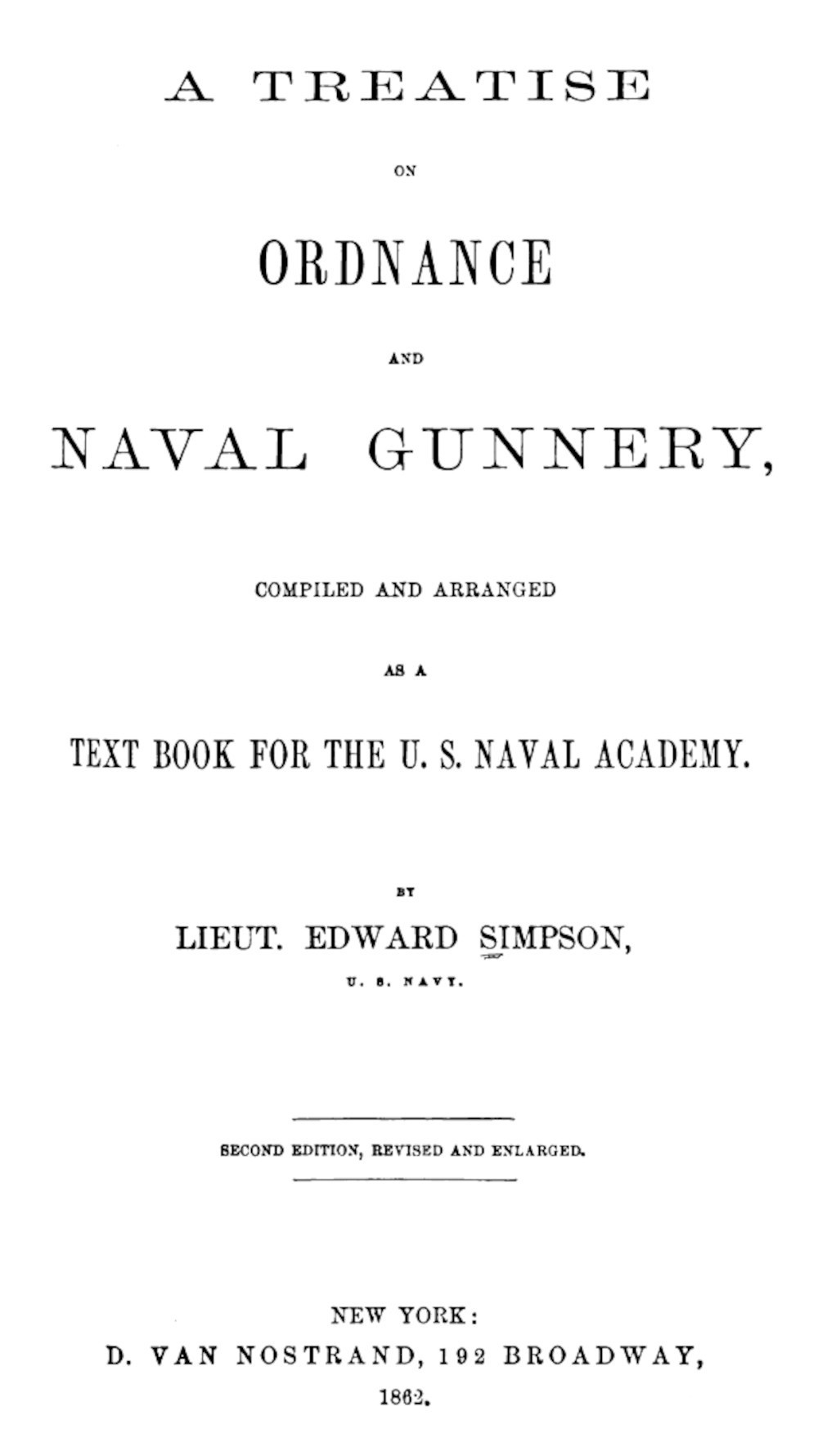
Tu można pobrać książkę w wersji elektronicznej: Google
Kompilator tego tomu, kiedy został poproszony o objęcie kierownictwa nauczania artylerii morskiej w Akademii Marynarki Wojennej, nie mógł znaleźć ani jednej pracy, która obejmowałaby grunt niezbędny do podstawowego kursu w tej dziedzinie. W zasięgu ręki było wiele dobrych dzieł, ale każde dotyczyło jakiejś specjalności autora, którą, jak się zdawało, zamierzał przedstawić; żaden tom nie był wystarczająco obszerny, aby zaspokoić potrzebę. Konieczne stało się więc zebranie z każdej części takich części, które po połączeniu mogłyby objąć cały temat. Niniejszy tom jest wynikiem wysiłków autora zmierzających do osiągnięcia tego celu. Przesyłając swoją pracę do Marynarki Wojennej, autor chce być zrozumiany jako osoba podejmująca wysiłek rozpowszechniania informacji, których wielu oficerów, ze względu na ciągłą służbę na wodzie, mogło nie być w stanie zebrać. Informacje te starał się zebrać razem w czytelnej i znajomej formie i unikał w miarę możliwości wszelkich naukowych demonstracji, czyniąc pracę elementarną w swoim charakterze."
Spis treści w j. angielskim:
- Chapter I.
- Review of ancient arms.
- Ancient engines of war.
- Ancient men-of-war.
- Ancient artillery
- Invention of gunpowder and ancient cannon, with account of their earliest uses.
- Advance in gun-making.
- Battle of lepanto.
- Mortar.
- Introduction of carronades.
- Resume of the history of calibre.
- Experience of war of 1812.
- Maximum calibres now in use in the United States Navy.
- Chapter II. Fabrication of cannon.
- Cast-iron, wrought-iron, bronze.
- Fabrication of cannon.
- Boring.
- Casting on a core.
- Turning.
- Vent-pieces.
- Weakness of wrought-iron cannon.
- Nomenclature of cannon.
- Inspection of cannon.
- Proof of cannon.
- Marking cannon.
- Chapter III. Cannon.
- Form of cannon.
- Bomford's plan for determining form.
- Recoil, effect of, on cannon and small arms.
- Windage.
- Preponderance.
- Phenomena in bore on combustion of the charge.
- Professor treadwell on lodgements.
- Increase of strain due to increase of calibre.
- Injury to bronze cannon ; drooping at the muzzle.
- Injury to cannon in proof.
- Strengthening bands on cannon.
- Mr. Robert mallet on planes of weakness.
- Professor treadwell on fractures.
- Effect of vibration.
- Effect of shrinking in cooling.
- Casting on a core, or hollow casting.
- Effect of trunnions.
- Effect of age on endurance.
- To render cannon unserviceable.
- Preservation of cannon.
- Chapter IV. Gun-carriages.
- Conditions required of a gun- carriage.
- Friction carriages.
- Breeching. compound breeching.
- Effect of height of carriage.
- Iron carriages.
- Navy four-truck carriage.
- Ward's gun-carriage.
- Marsilly (navy two-truck) carriage.
- Romme carriage.
- Marshall carriage.
- Ehrestham carriage.
- Pivot carriages.
- Van Brunt's carriage.
- Bed and quoin.
- Elevating screw.
- Ward's screw-quoin.
- Porter's quoin.
- Rule for mounting guns.
- Chapter V. Gunpowder.
- Discovery of gunpowder.
- Nitre walls, beds.
- Charcoal.
- Sulphur.
- Manufacture of gunpowder.
- Packing gunpowder.
- Phenomena attending the change from a solid to a gaseous state.
- Combustion, causes that influence the rapidity of.
- Harmlessness of non-elastic force.
- Proof of powder.
- Eprouvette.
- Ballistic pendulum.
- Loss of force by windage.
- Effect of junk wads.
- Effect of reducing windage.
- Rotary machine.
- Navez's machine.
- Storage of gunpowder
- Damaged gunpowder.
- Gun-cotton.
- Chapter VI. Projectiles.
- Casting.
- Inspection.
- Bar-shot.
- Chain- shot.
- Grape- shot.
- Canister shot.
- Shells.
- Spherical case.
- Carcasses.
- Sabots.
- Martin's shell.
- Norton's liquid fire.
- Resistance of the atmosphere.
- Windage.
- Deviations.
- Magnus' experiment.
- Eccentricity, effect of.
- Advantage of large calibre.
- Advantages of the spherical and elongated form.
- Penetration.
- Rockets.
- Manufacture.
- Congreve rocket.
- Motive power of rockets.
- Uncertainty of rocket practice.
- Rockets fired from cannon.
- Hale's rocket.
- Hale's rocket tube for broadside firing.
- Chapter VII. Fuzes.
- Fuze-case.
- Safety plug.
- Water cap.
- English fuze.
- Splingard's shrapnel fuze.
- Bormann fuze.
- French shrapnel fuze.
- Concussion fuzes.
- Prussian fuze.
- Schonstedt fuze.
- Snoeck fuze.
- Splingard's concussion fuze.
- Percussion fuze.
- Moorsom's fuze.
- Bourbon fuze.
- Fuze used during experiments at west point.
- Chapter VIII. Locks and primers.
- Early methods of firing cannon.
- First application of locks to cannon.
- Percussion system.
- Navy percussion primer.
- English primer.
- Navy locks.
- Late improvement in mounting the hammer.
- Friction primers.
- English navy friction primer.
- Chapter IX. Theory of pointing guns.
- Preliminary.
- Trajectory in a vacuum.
- Height of the curve.
- Range.
- Resistance of the air.
- All deviations not due to errors of pointing.
- Trajectory in the air.
- Height of the curve.
- Angle of greatest range.
- Direct fire.
- Pointing.
- Point blank.
- Tangent scale.
- Negative hausse.
- Dispart sight.
- Use of graduations between "level" and range at level.
- Marking breech sights.
- Relation between total hausse and time of flight.
- Deviations resulting from a difference of level in the trucks.
- Chase firing.
- Pendulum hausse.
- Side pointing.
- Pointing by means of the handles.
- Tangent firing.
- Ricochet firing.
- Chapter X. Rifles
- Inaccuracies that the rifle is intended to correct.
- Object of the rifle motion.
- Methods of imparting the rifle motion.
- Breech loading, Maynard's rifle.
- Delvigne's rifle.
- Rifle à Tige.
- Gaining twist.
- The helix.
- Ball à Culot.
- Pritchet bullet.
- United States Navy bullet.
- Greener's expansive bullet.
- Theory of rifle motion, drift.
- Advantages of the elongated form of bullet.
- Grooves on the bullet, french theory.
- Magnus' theory of the deviation of elongated projectiles.
- Rifled cannon.
- French rifled cannon.
- Lancaster gun.
- Cavalli gun.
- Wahrendorff gun.
- The Armstrong gun.
- The Armstrong shell.
- The Armstrong carriage for broadside use.
- Professor Treadwell's plan for constructing cannon.
- The Whitworth gun.
- Advantages of rifled cannon limited to long ranges.
- Comparison of the armstrong and whitworth guns.
- Objections to breech-loading cannon.
- James's rifle shot.
- Sawyer's shell.
- Parrott's rifled cannon and shell.
- The Schenkl rifle shell.
- Chapter XI. Practice of gunnery.
- Double shotting.
- Effect of shot on iron.
- Iron-cased ships.
- Jones's inclined sides.
- Cole's revolving towers.
- "LA GLOIRE".
- The "WARRIOR".
- Determining distance of objects at sea.
- Practice of firing at sea.
- "HORNET" and "PEACOCK".
- "AVON" and "WASP".
- "FROLIC" and "WASP".
- Loading in one motion.
- Explosion of shells on concussion.
- Concentration of fire.
- Effect of projectiles.
- Naval duels.
- "GUERRIÈRE" and "CONSTITUTION".
- Receiving an attack from to windward.
- "MACEDONIAN" And "UNITED STATES".
- Receiving an attack from to leeward.
